Scientific Architecture
The Aurealix Architecture — Version 2.0
A technology-independent conceptual framework for adaptive bioelectronic and biopharmaceutical research.
The architecture defines scientific questions and relationships while remaining distinct from specific devices, algorithms, patent-protected implementations and claims of clinical efficacy.
Integrated architecture
Observation, reasoning, validation and longitudinal change.
Version 2.0 organizes six complementary frameworks across functional observation, peripheral interpretation, physiological state, uncertainty, transitions and longitudinal physiological reorganization.
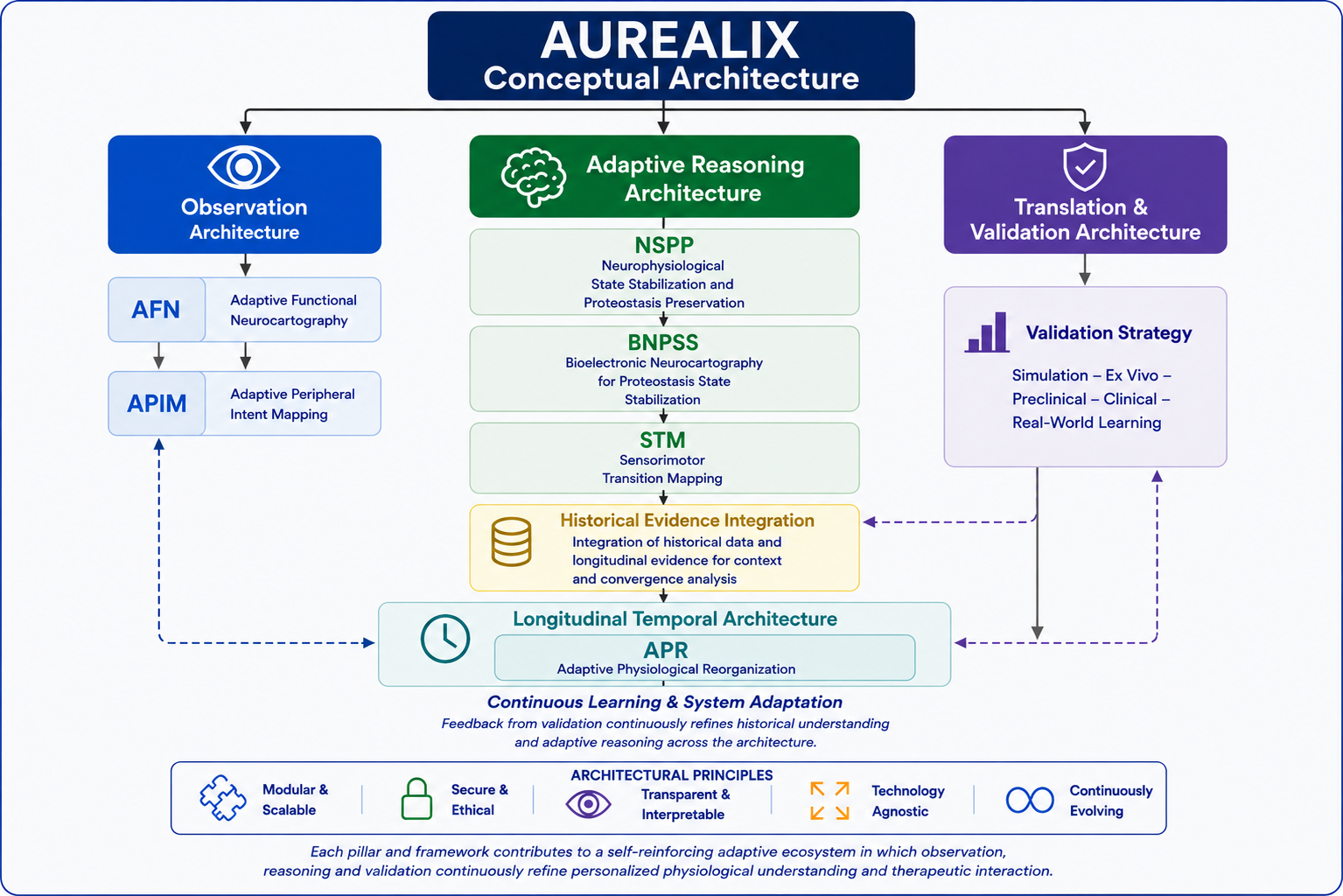
Foundational research architectures
Distinct questions. Complementary responsibilities.
The frameworks are scientific architectures rather than products. Public descriptions intentionally remain at the level of research purpose.
AFN
Adaptive Functional Neurocartography.
Functional observation and individualized response mapping.
APIM
Adaptive Peripheral Intent Mapping.
Peripheral physiological interpretation in the context of intended function and adaptive interfaces.
NSPP
Neurophysiological State Stabilization and Proteostasis Preservation.
Representation of neurophysiological state in relation to stabilization and proteostasis research.
BNPSS
Bioelectronic Neurocartography for Proteostasis State Stabilization.
Uncertainty-aware physiological reasoning under incomplete and variable information.
STM
Sensorimotor Transition Mapping.
Research into transitions between functional and neurophysiological states.
APR
Adaptive Physiological Reorganization.
Longitudinal physiological reorganization and model correspondence over time.
Emerging research architecture
Adaptive Bioelectronic Intervention.
ABI provides a research context for studying adaptive bioelectronic intervention while keeping experimental evidence, safety and validation distinct from conceptual architecture.
Emerging research architecture
Probabilistic Pathological State Transition Stabilization.
PPSTS investigates partially observable physiological states, trajectories, instability and bounded intervention under uncertainty.
Architectural boundary
Architecture is not implementation.
Specific sensing modalities, computational methods and therapeutic technologies remain implementation-dependent and require separate technical and scientific validation.
Patent-protected mechanisms and unpublished technology directions are not disclosed through the public architecture.